The material is reproduced here with original illustrations.
The shaft or shaft sleeve should be in good condition. Run-out of more than .003" should not be accepted. A shaft with whip or runout opens the space between the shaft and the packing, which makes excessive leakage inevitable.
An example of the problem of shaft whip is of interest - In a pump with a 50 lb. impeller running at 3600 RPM, with a shaft runout of .003"; i.e. .006"across the diameter, the shaft will exert a force of 56 lb., 3600 times per minute. Under these circumstances it is virtually impossible for the packing to seal against the shaft, excessive leakage will occur. The packing is generally blamed for the failure.
One item of pump condition often overlooked is the state of the stuffing box. Rough or pitted surfaces make for difficult sealing on the O.D. and prevent proper adjustment of the gland, due to excess 'hang up' of the O.D. of the packing.
The correct size of packing is important, as square braided packings are made in such a way that distortion to another dimension distorts the sealing faces and creates the need for excessive gland pressure to prevent leaks, causing overheating, with it's attendant problems.
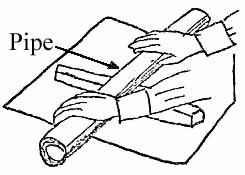
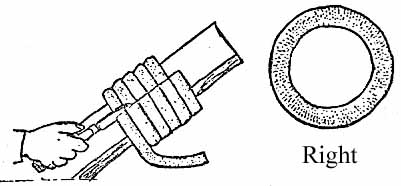
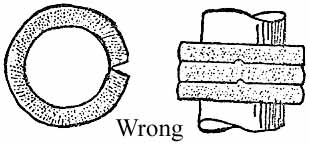
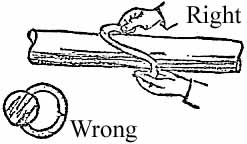
Packing rings should be cut square around a shaft of the same diameter as the pump being re-packed. A square cut avoids unravelling. Wrapping the packing around the shaft two or three times, then cutting longitudinally along the shaft, will ensure rings of the correct length with neatly fitting ends.
It has been proved that 70% of packing wear, and consequent shaft wear, takes place with the last two rings at the gland end, hence the need to spread the packing load as evenly as possible throughout the stuffing box.
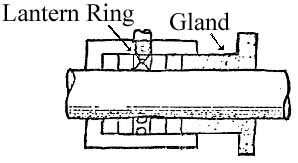
Once the turns of packing are installed, tighten the gland firmly, to ensure final seating of the packing, then free-off the adjusting nuts and re-adjust, to just over finger-tight. The gland should enter the stuffing box to the depth of one turn of packing.
Packing does not stop leakage, it only controls leakage.
A gland that has no leakage will overheat rapidly. Therefore, allow
a strong leakage rate initially and follow up adjustments, say one hexagon
flat (1/6 turn) every 15 minutes or so, until the leakage rate is
controlled. Be careful not to cause overheating during the process,
backing-off the gland adjustment if necessary.
Final leakage rate of a gland varies with different products, shaft speeds
and shaft diameters. As a starting point, a leakage of one drop at
least every 10 minutes is generally acceptable. As shaft diameters
and speeds increase, so should the leakage rate, e.g. a 2" shaft
should leak one drop at least every 5 seconds.
This adjustment procedure can take several hours. It is
unfortunate that such care is rarely taken in practice.
Glands are most often over-tightened too quickly, with lubricant being
forced out of the packing and both shaft and packing life shortened.